Second in a three-part Euromaidan Press investigation into the Russian oligarch Oleg Boyko, his European business network, and the gaps in the West’s sanctions regime.
At the Krakovets crossing on the Polish border, Ukrainian border guards found 840 electronic cigarettes in the Audi of a 43-year-old from Lviv Oblast, hidden under the hood and in the trunk—part of a haul worth more than 800,000 hryvnia ($18,000). It was an unremarkable interception. On Ukraine’s western frontier, officers now pull smuggled vapes from cars routinely.
More than 93% of the e-cigarettes sold in Ukraine are illegal, and the network behind it traces to Oleg Boyko.
The seizure is a glimpse of a market that has gone almost completely dark. More than 93% of the e-cigarettes sold in Ukraine are illegal; the trade cost the wartime budget about $171 million in 2025; and the network behind it traces to Oleg Boyko, a Russian oligarch named on the US Treasury’s Putin List and under sanctions in Ukraine, Poland, and Australia, but not in the European Union, the single market his vapes cross.
The 93% comes from Kantar Ukraine, which conducted a market survey in mid-2025. The illegal share is highest in disposables and refillable-cartridge devices, where it nears 100%. Only half the products examined carried a verifiable excise stamp, and the surest sign of an illegal device was a non-tobacco flavor—the fruit and candy profiles that sell to the young. The study was commissioned by Ukraine’s largest tobacco manufacturers, who lose sales to the shadow trade.
In November 2023, Vladislav Inozemtsev and Mykola Vorobiov warned that a Kremlin-linked network was fueling Europe’s vape boom.
“In the case of e-cigarettes, we see a record-high level of illegality—over 90 percent of the market,” said Tetiana Sverdlyk, an analyst at Kantar Ukraine.
None of this arrived unannounced. In November 2023, the Russian economist Vladislav Inozemtsev and the Ukrainian journalist Mykola Vorobiov warned in Gazeta Wyborcza that a Kremlin-linked network centered on Boyko was fueling Europe’s vape boom and draining Ukraine’s budget.
Two and a half years on, the warning reads like a forecast.
More than half the market was already untaxed, they wrote, with supplies routed through tax warehouses in Poland and Slovakia, and the state losing at least 280 million hryvnia ($7.6 million) a month in excise.
Their article was later removed from the Wyborcza website, as the first article in this series recounted. Euromaidan Press has obtained the original text. Two and a half years on, the warning reads like a forecast: nearly all of that market is now illegal.

The cost, and the chase
The cost is fiscal, and it falls on a wartime budget. The Growford Institute estimates Ukraine lost more than 7.6 billion hryvnia ($171 million) to the illegal e-cigarette market in 2025—5.6 billion hryvnia ($126 million) in unpaid excise and another 2 billion hryvnia ($45 million) in value-added tax.
Ukraine has hardened the law. Selling, storing, or transporting unmarked excisable goods—e-cigarette liquids among them—is a criminal offense under Ukraine’s Criminal Code. Enforcement is real, but it works one case at a time.
The Economic Security Bureau filed a case against an operator who was caught with industrial bottling lines.
In May 2026, the Economic Security Bureau filed a case against an operator who was caught with industrial bottling lines, 70 boxes of unstamped e-cigarettes, and a set of shadow accounts.
Border seizures and bottling-plant raids catch the couriers and the copycats. They do not reach the structure that makes the trade worth the risk.
The network behind the brand
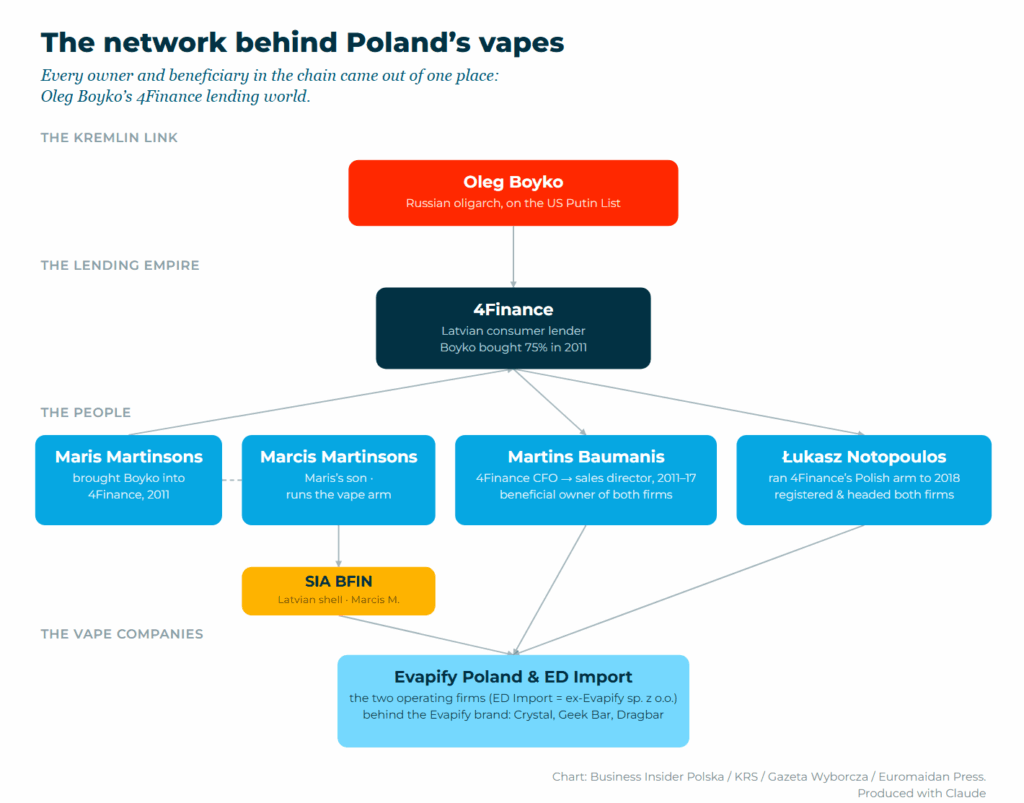
That structure was detailed in the Wyborcza investigation. Behind the Polish vape business stand two companies—Evapify Poland and Evapify sp. z o.o., since renamed ED Import—whose beneficial owner is Martins Baumanis, a Latvian and a former senior executive at Boyko’s 4Finance. The Pole named as its head is Łukasz Notopoulos; day-to-day control runs through a Latvia-registered shell, SIA BFIN, held by Marcis Martinsons.
Every owner and beneficiary had come out of that same micro-lending world.
Maris Martinsons—not to be confused with his son Marcis, whose name differs by one letter—was a decade earlier among those who brought Boyko into Latvia’s 4Finance lender. Maris opened the door to the lending empire; Marcis now runs the vape arm. Every owner and beneficiary, Inozemtsev and Vorobiov found, had come out of that same micro-lending world.
A year later, Polish media reached the same conclusion independently. Business Insider Polska confirmed that Evapify, the leading distributor of disposable e-cigarettes in Poland, traces back to Baumanis and through him to Boyko.
In December 2024, the public broadcaster TVP revealed that the company rents a private hospitality suite at the stadium of Legia Warsaw, Poland’s top football club—its walls lined with banned vape advertising in plain view of fans, children among them—and that a device costing around a dollar to make in China sells in Europe for up to ten. Spider’s Web puts Poland’s disposable market alone at more than 1 billion złoty (about $275 million).
The company said Baumanis created the Evapify brand but “holds no supervisory or operational role in ED Import or Evapify Poland.”
Evapify rejects the idea that the connection runs through its operations. In a statement to Business Insider Polska, the company said Baumanis created the Evapify brand but “holds no supervisory or operational role in ED Import or Evapify Poland.”
Corporate records show the same hands behind both operations. Notopoulos was chief executive of Vivus Finance—then the Polish arm of 4Finance, the short-term consumer-lending group Boyko had invested in—until 2018, and also ran other 4Finance entities.
In December 2021, he registered both Evapify companies within a day of each other, then passed the chief executive seats, one by one, to the same associates who had run the loan business—a quiet migration from consumer credit to disposable nicotine.
The man the EU left off
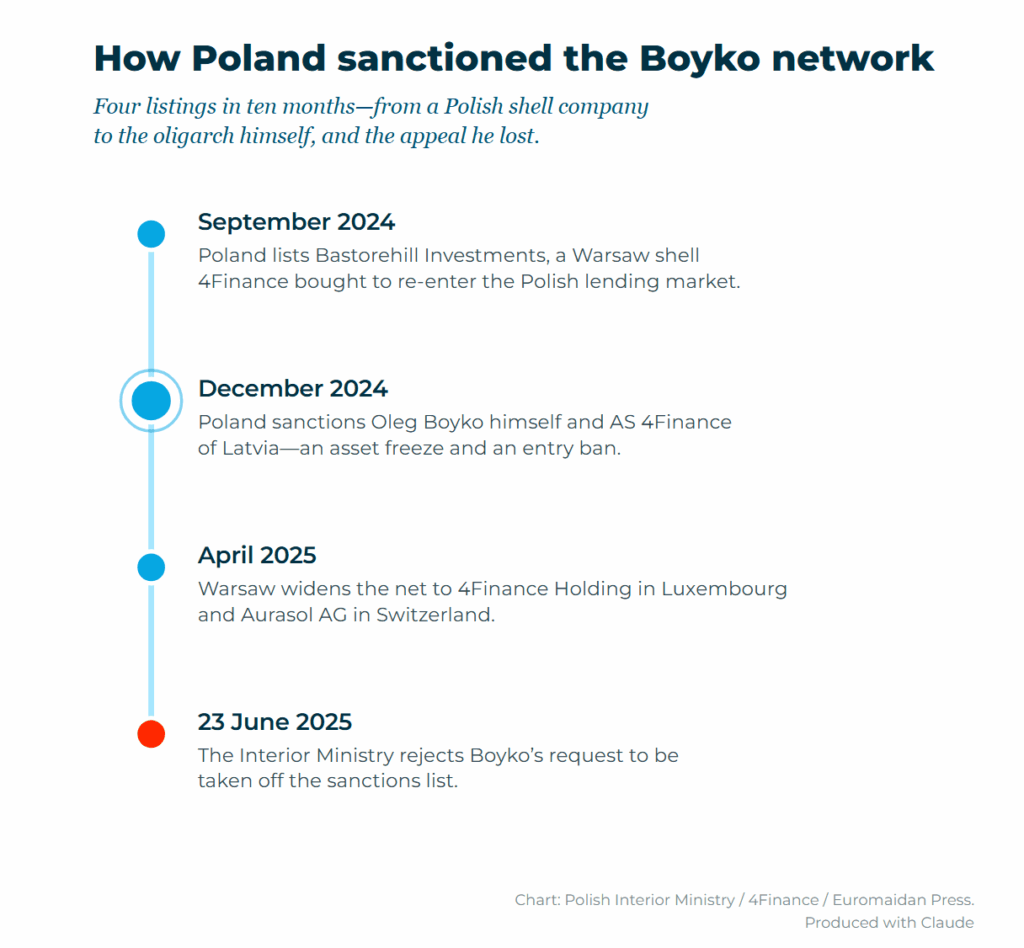
Boyko is on the Putin List, the US Treasury’s 2018 register of the oligarchs closest to the Kremlin, and he is under sanctions in Ukraine, Poland, and Australia.
In March 2026, the EU’s highest court affirmed that an oligarch’s economic weight alone can justify sanctions.
Poland sanctioned him personally in December 2024, concluding he has ties to Russian intelligence and organized crime; the listing reached entities across his 4Finance network but not Evapify.
His mother had long held his stake, and after Russia’s 2022 invasion, the family divested 4Finance—shares passed to Ukrainian relatives and a Swiss nonprofit, the rest to non-Russian owners—yet Poland sanctioned him and the lender anyway. Boyko sought removal, and in June 2025, the ministry refused.
The European Union does not sanction him. In March 2026, the EU’s highest court affirmed that an oligarch’s economic weight alone can justify sanctions, not just proven personal conduct. Brussels has not moved.
What the youngest pay
The cost is not only counted in hryvnia or in złoty. The disposables that dominate this trade feature bright colors and sweet flavors—and they’re cheap. In Poland, they are sold and advertised in the open, down to the banned banners at the Legia Warsaw suite, where children can see them; in Ukraine, the same devices arrive smuggled. The target on both sides of the border is the same: young.
About one in five Polish 15-to-16-year-olds vapes every day—the highest daily rate in Europe.
Nowhere is that toll clearer than in Poland, Evapify’s home market. About one in five Polish 15-to-16-year-olds vapes every day—the highest daily rate in Europe, where the range runs from 1.5% in the Faroe Islands up to Poland’s 20%.
Counting anyone who used an e-cigarette in the past month, the Polish share is 36%, again the highest of any country, the 2024 ESPAD survey of European students found.
The network keeps a private suite at a Warsaw football stadium, and the oligarch it traces to has never appeared on a European Union sanctions list.
At the Krakovets crossing, the man with the Audi lost his 840 vapes and will pay a fine. The network behind that kind of cargo keeps a private suite at a Warsaw football stadium, and the oligarch it traces to has never appeared on a European Union sanctions list. The couriers are caught one car at a time. The pipeline behind them runs on.