the-western-us.-tried-to-stop-wildfires-and-it-backfired

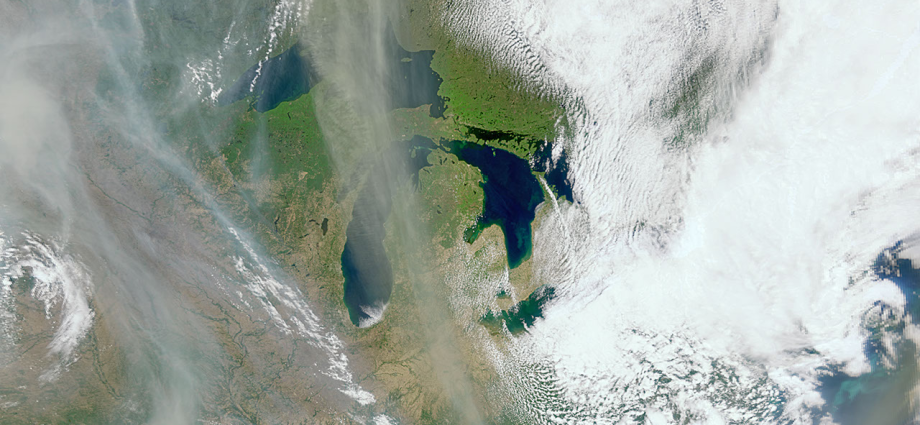
Much of the western U.S. is overdue for wildfire, with decades of suppression allowing fuel to build up across millions of hectares. Researchers estimate that 74% of the region is in a fire deficit, meaning far more land needs to burn to restore healthy forest conditions. Catching up would requireContinue Reading

dr.-john-sullivan

Dr. John Sullivan Atmosphere and Enabling Capabilities Program Manager Dr. John T. Sullivan is currently serving on detail at NASA Headquarters since Spring 2025 as the Ground-Based Networks and Calibration/Validation Facilities Program Scientist and Deputy Program Manager for the Multi-Source Integrated Observatory. With a background in the Atmospheric Chemistry andContinue Reading

moon-mascot:-nasa-artemis-ii-zgi-design-challenge

4 min read Moon Mascot: NASA Artemis II ZGI Design Challenge A graphic for the Moon Mascot: NASA Artemis II ZGI Design Challenge. Freelancer Whose Moon Mascot design will join the Artemis II astronauts on their historic voyage around the Moon in early 2026? Between March 7 and Jun. 16,Continue Reading

webbys-fyc-2025:-nasa-newsletter

NASA Newsletter NASA’s weekly newsletter is delivered every Friday and offers a curated look at the week’s top stories, from Earth to the Moon, the Solar System, and beyond. Current Edition about NASA Newsletter SUBSCRIBERS 5+ million OPEN RATE 34-36% The Newsletter For the Benefit of Humanity NASA’s flagship newsletterContinue Reading

mihailo-derek-rutovic 

Mihailo Derek Rutovic  Director, Airborne Science Program, Earth Science Division  Derek Rutovic has served as the director of the Airborne Science Program (ASP) since June 2025.  As the ASP director, he is responsible for managing the cost, schedule, and performance of the aircraft NASA uses to meet Earth Science airborneContinue Reading

dr.-ed-nowottnick 

Dr. Ed Nowottnick  Program Manager, Radiation Sciences Program, Atmosphere, Earth Science Division Ed Nowottnick serves as the program scientist for the Radiation Sciences Program for the Atmosphere within NASA’s Earth Science Division’s Research and Analysis (R&A) Program since March 2025. As Radiation Sciences Program manager, his focus is reducing uncertaintiesContinue Reading

dr-k.-emma-knowland

Dr. K. Emma Knowland Atmosphere Program Manager – Tropospheric Composition Research Dr. K. Emma Knowland is a Program Manager and Program Scientist at NASA HQ in the Science Mission Directorate’s Earth Science Division, where she manages the Tropospheric Composition Program (TCP) and serves as Program Scientist for several key NASAContinue Reading

dr.-amanda-whitehurst

Dr. Amanda Whitehurst Biosphere Program Manager – Terrestrial Ecology Research Dr. Amanda Whitehurst currently serves as the Program Manager for Biosphere in NASA Earth Science Research and Analysis Element. Amanda is also a Program Scientist for GEDI, LVIS, STV, and NISAR. In 2020, she joined Earth Science Division Flight ElementContinue Reading

nasa-lab-completes-engine-checks-on-new-aircraft

NASA/Christopher LC Clark Justin Hall, left, controls a subscale aircraft as Justin Link holds the aircraft in place during preliminary engine tests on Friday, Sept. 12, 2025, at NASA’s Armstong Flight Research Center in Edwards, California. Hall, chief pilot at the center’s Dale Reed Subscale Flight Research Laboratory, and Link,Continue Reading

nasa-instrument-reveals-new-ability-to-gather-nighttime-light-data

Clusters of light across North America as observed by the TEMPO instrument in February 2025. This false-color image represents the total light observed from that location, with red being the brightest. The TEMPO instrument observes more than 2,000 wavelengths of light at each location. NASA NASA’s Tropospheric Emissions: Monitoring ofContinue Reading

nasa’s-punch-releases-refined-images-of-eruptions-from-the-sun

NASA’s PUNCH (Polarimeter to Unify the Corona and Heliosphere) mission has released processed images of huge eruptions from the Sun, known as coronal mass ejections (CMEs), that occurred from Oct. 21 to Nov. 12. This release marks the first time PUNCH observations can be used to continuously trace solar eruptionsContinue Reading